
Written by Jacilene Arruda – tourismologist, writer, journalist, philanthropist, and Muslim
Violence against women is a structural phenomenon that crosses borders and cultures, manifesting itself in different intensities around the world. In Brazil, the numbers are alarming: according to the Atlas of Violence/Ipea, 1,350 femicides were recorded in 2020, 1,366 in 2021, and 1,437 in 2022. In 2023, according to Agência Brasil, the number reached 1,438, and in 2024, according to the Ministry of Justice, there were 1,464 cases. In 2025, the Feminicide Monitor of UEL reported 1,470 deaths, which represents almost four women murdered per day.
On the international stage, the situation is also serious. The SESNSP of Mexico reports about 700 femicides annually between 2023 and 2025. In Europe, Eurostat data indicate 107 cases in France in 2024, about 120 in Germany, and 60 in Spain. In Asia, UN Women estimates that India registers approximately 20,000 annual deaths related to domestic violence or the so-called “dowry deaths,” while Pakistan records about 1,000 honor crimes per year. Globally, UNODC and UN Women report that 83,000 women were murdered in 2024, 50,000 of them by intimate partners or family members.
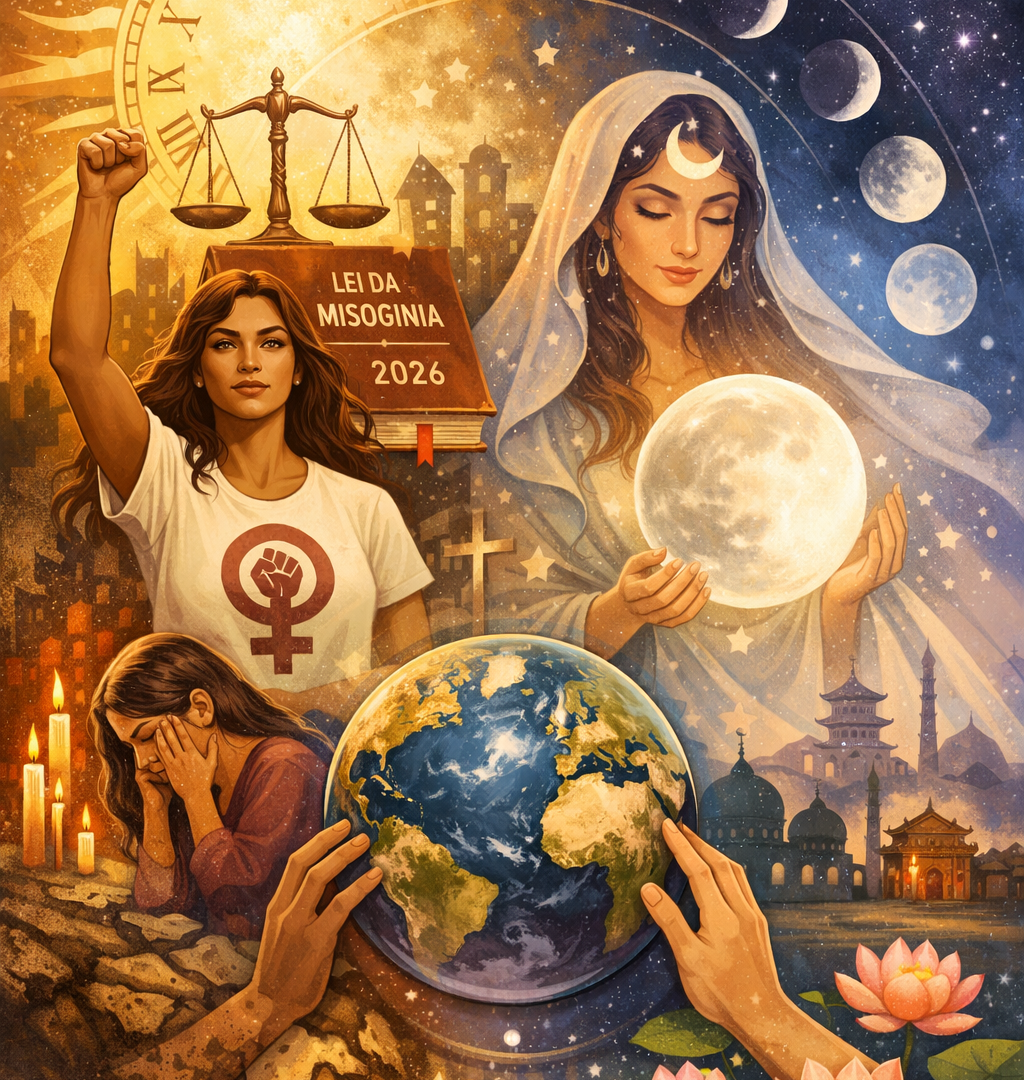
Faced with this reality, Brazil made legislative progress with the approval, in March 2026, of the law that criminalizes misogyny, equating it to racism. The bill provides for sentences of two to five years in prison and makes the crime non-bailable and imprescriptible. This measure expands the protection of women, recognizing that violence is not limited to the physical sphere but also manifests itself in hate speech and symbolic practices that reinforce inequality.
However, overcoming violence requires more than laws: it is necessary to transform mentalities. In this sense, the concept of the sacred feminine offers a symbolic and spiritual perspective that values women as bearers of vital cycles, intuition, and wisdom. The Moon, with its phases — new, waxing, full, and waning — is traditionally associated with the feminine and the natural rhythms of the female body. While the Gregorian calendar, solar-based, reflects a linear and rational view of time, the Islamic (lunar) and Hindu or Chinese (lunisolar) calendars reveal a cyclical and spiritual perception, closer to the logic of the sacred feminine.
Therefore, by uniting concrete data on femicide and gender violence with cultural and spiritual reflections, it becomes clear that addressing this problem must be multidimensional. Statistics highlight the urgency of effective public policies, while the rescue of the sacred feminine points to a change in mentality capable of inspiring respect and balance. Only by integrating legislation, education, and culture will it be possible to build a society in which feminine energy is recognized and gender violence finally overcome.
Sources:
- Atlas of Violence/Ipea (2020–2022)
- Agência Brasil (2023)
- Ministry of Justice/G1 (2024)
- Feminicide Monitor of UEL (2025)
- SESNSP Mexico (2023–2025)
- Eurostat/Euronews (France, Germany, Spain, 2024–2025)
- UN Women and UNODC (Global reports 2023–2024)
- Brazilian Senate (Misogyny Law, approved in March 2026)